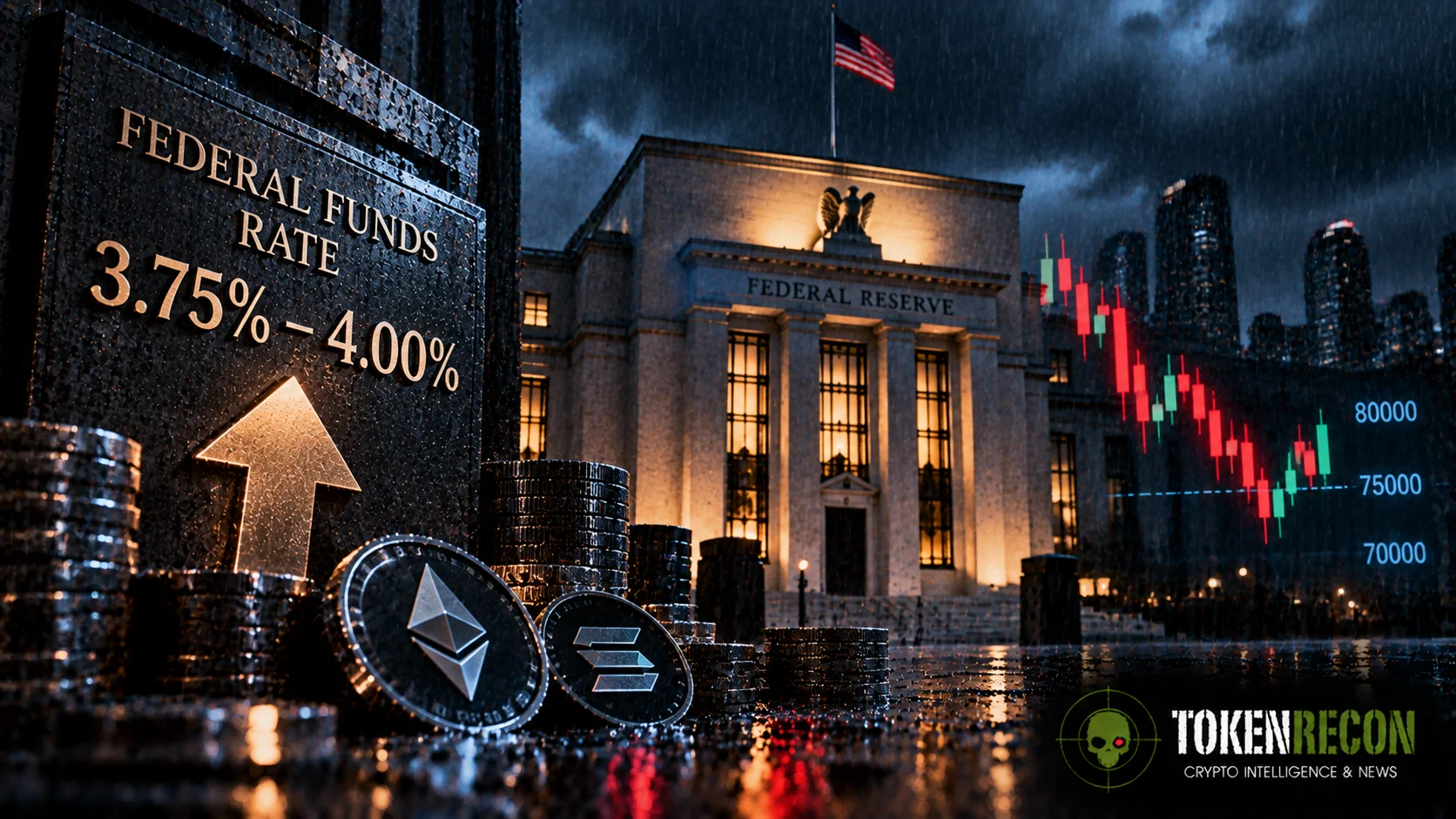

The Federal Reserve has raised its benchmark interest rate by 25 basis points, ending a period of more than three years without an increase and opening a new tightening cycle while Bitcoin remains near a critical market-support zone.
The Federal Open Market Committee voted unanimously to raise the federal-funds target range to 3.75%–4%, according to the official September 16 FOMC statement.
The decision was widely expected, but its importance extends beyond the quarter-point move. It confirms that the Federal Reserve now considers inflation risk serious enough to resume tightening despite geopolitical uncertainty, elevated energy prices and growing pressure on interest-sensitive sectors.
The central bank described economic activity as expanding at a solid pace. It also cited resilient domestic spending, strong productivity, robust capital investment and a labor market in which job creation has largely kept pace with workforce growth.
Inflation remains the primary concern. The FOMC said price pressures were still elevated and that tighter policy was intended to return inflation toward its 2% target more quickly.
The accompanying projections indicate that policymakers expect additional tightening. CoinDesk’s analysis of the September projections found that the median rate path points toward one additional increase before the end of 2026.
Fed Chair Kevin Warsh argued that the rise in long-term bond yields reflects economic strength, capital investment and geopolitical risk more than a collapse in confidence in the central bank. Reuters reported that Warsh highlighted technology and AI infrastructure spending as important sources of capital demand.
That interpretation is important for crypto. If yields are rising because investment demand is strong, risk assets may absorb tighter financial conditions more successfully than they would during a credibility or sovereign-debt crisis.
The competing interpretation is less favorable. Higher long-term yields still increase the return available on Treasury securities and raise the discount rate applied to speculative assets, regardless of why the yields are rising.
Commercial borrowing costs have already moved. Major U.S. banks raised their prime lending rate from 6.75% to 7% following the Fed decision, according to Reuters.
That change affects credit cards, business loans and other floating-rate borrowing. Higher consumer and corporate financing costs can slow spending and reduce the amount of capital moving into equities, venture investments and digital assets.
Bitcoin initially fluctuated around $75,700 after the announcement before recovering above $76,000. Ether and Solana also regained part of their losses, while the broader CoinDesk 20 index advanced more than 2% during the overnight session.
The recovery should not be mistaken for confirmation that the rate hike is bullish. The decision was heavily anticipated, so part of the reaction reflects the removal of event uncertainty rather than a new source of demand.
Bitcoin’s current position also resembles earlier moments when the Federal Reserve began a tightening cycle after an extended pause. The most consequential comparison is not the first-day reaction. It is how liquidity, bond yields and credit conditions evolve during subsequent meetings.
Energy prices add another layer. Record or near-record diesel prices can feed into transportation, manufacturing and food costs, making inflation more persistent and increasing the risk of additional rate increases.
The Fed is therefore tightening into an unusual environment: economic growth remains positive, technology investment is strong, geopolitical risk is elevated and energy inflation is threatening to reach consumers through multiple channels.
For cryptocurrency markets, that combination creates competing forces.
Institutional blockchain adoption, stablecoin settlement and tokenization continue to grow. At the same time, the cost of capital is increasing, legislative certainty has been delayed and spot Bitcoin ETFs recently recorded substantial net redemptions.
TOKEN RECON ASSESSMENT
The first rate increase matters less than the path that follows it.
Bitcoin has so far defended the $75,000 position, but the market remains exposed to three monetary-policy risks:
- Another increase at the October meeting
- Higher long-term Treasury yields
- Persistent energy inflation forcing a longer tightening cycle
The constructive signal is that Bitcoin recovered above $76,000 instead of extending the liquidation wave immediately after the announcement.
The warning signal is that the market remains below $80,000 and has not reversed the breakdown caused by the CLARITY Act defeat.
Token Recon is watching:
- Whether Bitcoin can convert $76,000 back into support
- The next inflation and employment reports
- The October FOMC rate decision
- Treasury yields and the U.S. dollar
- Diesel and crude-oil prices
- Spot Bitcoin ETF flows
- Perpetual-futures leverage after the recent liquidation wave
The immediate battlefield is $75,000 to $80,000.
Holding $75,000 preserves the recovery attempt. Reclaiming $80,000 would restore a stronger structure. Losing $75,000 would expose the deeper defensive zone around $69,000–$70,000.